
Case Study · Crisis & Emergency Response
South Pacific Division
Responds to Disasters
Deputy Public Affairs Officer · USACE South Pacific Division · December 2017
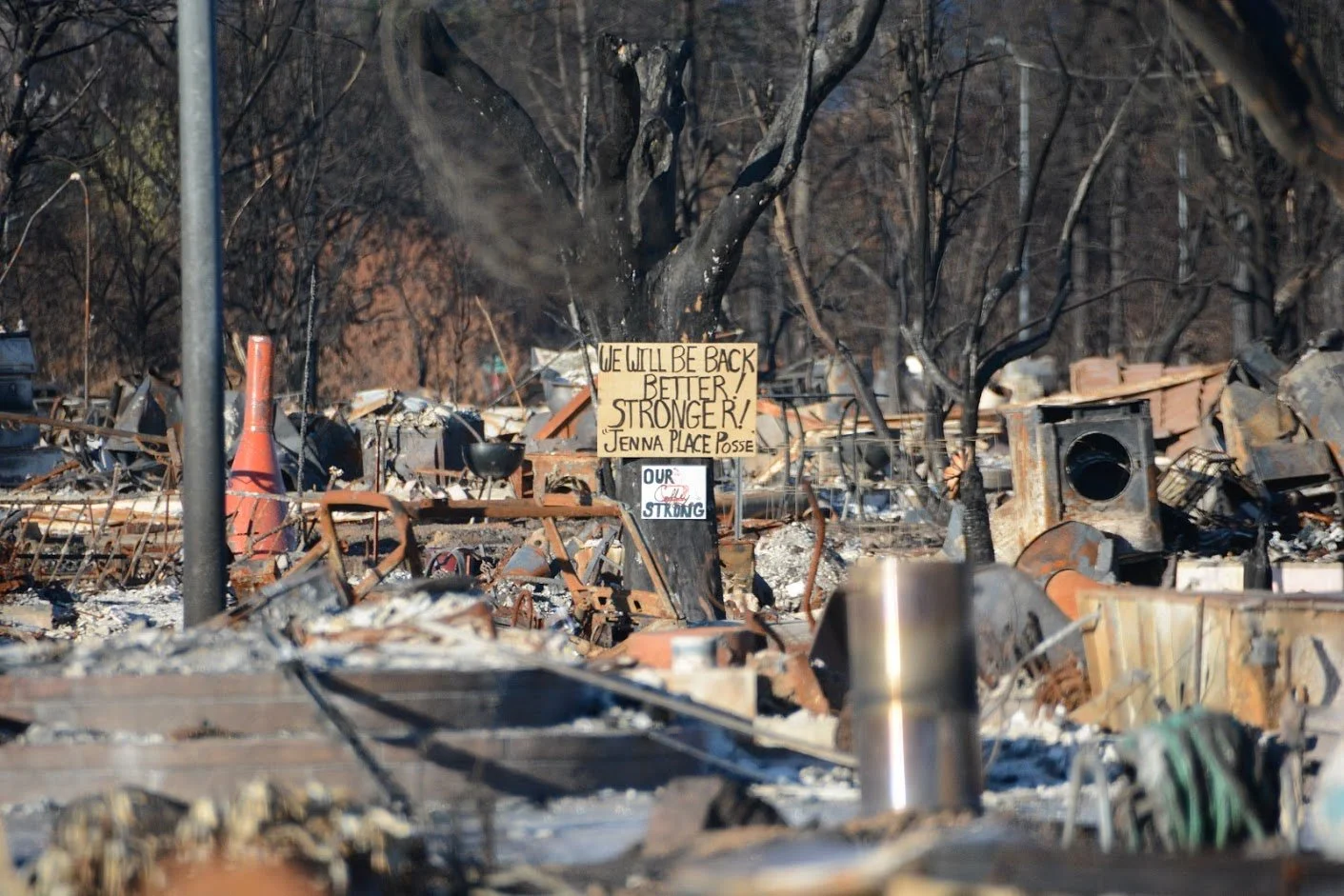
A sign of hope in the Coffey Park neighborhood of Santa Rosa, Calif., November 7, 2017. Contracted crews from the U.S. Army Corps of Engineers South Pacific Division conducted debris cleanup for residents devastated by the Northern California wildfires. Photo: Edward Coffey / U.S. Army.
Five major disasters inside of fifty-two days
Between August 17 and October 8, 2017, five major disasters struck the United States and its territories in rapid succession. Hurricanes Harvey, Irma, and Maria made landfall within 10 to 14 days of each other, devastating Texas, Florida, Puerto Rico, and the U.S. Virgin Islands. Before those missions were complete, Northern California erupted: the 2017 wine country wildfires killed 43 people, burned over a million acres, and destroyed more than 8,900 structures — causing upward of $3 billion in damage.
The U.S. Army Corps of Engineers South Pacific Division covers ten states in the Pacific Southwest, from northern California to West Texas. When those five disasters overlapped, SPD's four districts — Albuquerque, Los Angeles, Sacramento, and San Francisco — were simultaneously managing deployments to the Gulf Coast, the Caribbean, and their own backyard. This feature, written from San Francisco and published December 20, 2017, tells that story.
At a glance
- Hurricanes Harvey, Irma, and Maria struck within weeks of each other in 2017, sending USACE South Pacific Division personnel to Texas, Florida, Puerto Rico, and the U.S. Virgin Islands simultaneously.
- Before hurricane recovery was complete, Northern California wildfires forced SPD to redirect resources from the Caribbean to their own area of operations — managing two major disaster fronts at once.
- With 188 personnel deployed across active missions, SPD executed one of the most complex simultaneous disaster responses in the division's history.
SAN FRANCISCO — The U.S. Army Corps of Engineers South Pacific Division's area of responsibility covers 10 states in the Pacific Southwest, stretching from northern California to West Texas. When disaster strikes, the area of operations expands as Corps experts join a global team, responding immediately with assets deployed worldwide.
Between Aug. 17 and Oct. 8, 2017, five major disasters struck the U.S. and its territories. Hurricanes Harvey, Irma and Maria made landfall one after the other within 10 to 14 days of each other. In the immediate wake of the storms, personnel from South Pacific Division's four districts — Albuquerque, Los Angeles, Sacramento and San Francisco — deployed to the affected areas.
When disasters occur, Corps teams and other resources are mobilized from across the country to assist local districts and offices on response missions. The Corps has more than 50 specially trained response teams supported by emergency contracts to perform a wide range of public works and engineering-related support missions. Under the Stafford Act, the Corps supports the Federal Emergency Management Agency in carrying out the National Response Plan, which calls on 30 federal departments and agencies to provide coordinated disaster relief and recovery operations.
Under Stafford Act authorities, the Corps typically provides support to Emergency Support Function 3, which covers public works and engineering-related support for domestic incident management including preparedness, response and recovery actions.
After Hurricane Harvey struck Texas, South Pacific Division provided temporary housing on behalf of FEMA for those affected by the disaster. Los Angeles District executed the housing mission. Sacramento District provided infrastructure assessment and debris planning and response teams.
FEMA also launched Operation Blue Roof, a mission managed by the Corps to provide homeowners in disaster areas with fiber-reinforced sheeting to cover damaged roofs in Puerto Rico, the U.S. Virgin Islands and Florida.
One critical mission from FEMA was to provide emergency power to schools in the U.S. Virgin Islands. Brooks Hubbard, a public affairs specialist with Los Angeles District, deployed in support of hurricane relief efforts — to Houston from Sept. 1 to Sept. 19 and to the U.S. Virgin Islands from Oct. 10 to Nov. 9, 2017 — as part of the communications mission, which included outreach within affected communities.
"After the initial distribution of generator setups, an engineer arranged for a group of us to go to one of the schools and talk science, technology, engineering and mathematics," Hubbard said. "I was delighted to be part of helping kids up close in their recovery and hopefully influencing them toward a STEM career."
South Pacific Division personnel looked for every opportunity to engage with the community and build trust with residents and government leaders.
Sandra Eudy, an emergency management specialist with South Pacific Division, deployed to Puerto Rico from Oct. 26 to Nov. 28 as a cadre member supporting Emergency Support Function 3. She served as a local government liaison.
"We met with each mayor and emergency manager from all 15 municipalities," Eudy said. "I saw all the devastation and the work that the Corps was starting — from debris cleanup and generator installs to Operation Blue Roof. By the end of my tour I was comfortable knowing I had done a good job, relationships with the mayors were at a good point, debris removal was ongoing and Operation Blue Roof was beginning to gain momentum."
Just as power was returning to areas devastated by the hurricanes, another disaster struck closer to home for South Pacific Division personnel.
In October, the Northern California wildfires killed 43 people, burned more than 1 million acres and destroyed more than 8,900 structures across wine country, displacing thousands and causing more than $3 billion in damage.
Steven Martinson of Santa Rosa was among those displaced, sifting through the debris of what had been his home. Martinson had moved to the Coffey Park neighborhood on June 7, 1986. For many residents, the fire arrived with almost no warning.
"I'm trying to get my dog in bed and he was shaking," Martinson said. "Fifteen minutes later, a neighbor comes along and says, 'You've got five minutes to get out of here.'"
Through the debris, he found remnants of a lifetime: a damaged Nikon camera, ammunition from an old hunting rifle and the frame of his custom Harley-Davidson. Martinson, one of many Coffey Park residents to lose their homes in the fires, remained focused on rebuilding.
With disaster recovery already underway on multiple fronts, emergency management cadre from South Pacific Division managed the competing demands for Corps expertise in the field.
"The fires got out of control, FEMA requested our Emergency Support Function 3 activation," said John Beldin-Quinones, chief of readiness and contingency operations. "We had to stop sending people to Puerto Rico because we had to take care of our own area of operations, and that's difficult to do."
By mid-December, more than 480,000 tons of fire debris had been removed from more than 1,500 properties in the affected counties. As of Dec. 14, 188 South Pacific Division personnel were deployed in support of hurricane and wildfire relief efforts.
"We are committed to taking care of people in South Pacific Division," said Brig. Gen. Pete Helmlinger, commander of South Pacific Division. "Not just within our region, but across the Corps — with South Pacific Division members supporting hurricane recovery in places like Houston and Puerto Rico, as well as those overseas in places like Afghanistan and Iraq. Our personnel stand ready to advise and assist our partners here and beyond."
Finding the story in the debris
This feature was written from San Francisco while South Pacific Division personnel were still deployed across four active missions spanning Texas, Florida, Puerto Rico, the U.S. Virgin Islands, and Northern California. The challenge was to hold five simultaneous disasters in one readable narrative without flattening any of them — to give the hurricane response its full institutional weight while leaving room for the story that hit closest to home.
The Martinson interview wasn't planned. Walking the Coffey Park neighborhood on a community relations assignment — checking on residents, offering information on FEMA claims and USACE resources — I came across Martinson rummaging through what remained of his parcel. I stopped to ask how he was doing and whether there was anything I could give him that would help in recovery. He talked. I took notes, thinking I might be able to pull his experience into something later. That's where the story's human anchor came from: not an arranged interview, but a moment of community engagement that became journalism.
The institutional story — hurricane operations, ESF #3 activation, the mechanics of simultaneous multi-front response — earns its context by earning the reader's attention first. Martinson's five minutes of warning does that. Agency journalism earns its audience by finding the person inside the mission, not just the mission briefing. The Coffey Park photo was made with the same intention: what the disaster actually looked like at the human scale, not the aerial one.